

MALAYBALAY CITY (February 20, 2026) — The Agricultural Training Institute–National Livestock Program (ATI-NLP) is holding a four-day Consultative and Planning Workshop in Malaybalay City, bringing together livestock focal persons from across the country to align regional output with national demand
The February 17–20 workshop links regional programs to a national roadmap to boost local meat and dairy production, increase farmers’ incomes, and reduce reliance on imports. The plan covers breed improvement, disease control, climate-resilient farming, digital advisory services, and market access.
Malaybalay City Mayor Jay Warren Pabillaran welcomed the delegates, citing the city’s year-round climate as an advantage for continuous meat and dairy production.
“We have the environment. We simply need the resolve. I am confident in the Agricultural Training Institute and partner agencies to help professionalize livestock production. Stronger coordination between local and national planners will align output with demand and improve farmer earnings,” he said.
Pabillaran envisions that Malaybalay, the host city, will serve as a primary hub for advanced technical training and expanded “Artificial Insemination sa Barangay” initiatives. He noted that the city’s livestock sector stands to gain from upgraded breeding support and intensified disease-monitoring systems.
Also, Pabillaran is pushing for the establishment of additional Learning Sites for Agriculture (LSA) to optimize the skills and productivity of local farmers.
Dr. Ruth Miclat-Sonaco, ATI–International Training Center on Pig Husbandry and ATI-NLP focal person, said the agency’s ranking as the country’s top-performing National Livestock Program office reflects staff performance.
“We are committed to sustaining this momentum as we bring programs directly to the grassroots level where they are needed most,” Sonaco said.
Participants reviewed regional initiatives, including artificial insemination, forage development, breeder dispersal, techno-demo farms, dairy enterprises, biosecurity campaigns, and small ruminant upgrading. They aligned these efforts with national targets to ensure consistency and prevent overlap.
The group set priority actions for 2027–2028, including a nationwide rollout of unified livestock extension modules, expansion of “Artificial Insemination sa Barangay,” intensified training against African Swine Fever (ASF) and Avian Influenza, dairy and beef cattle upgrading, and youth engagement in livestock enterprises.
Planners also focused on high-impact programs, such as cattle and carabao breed improvement, backyard hog biosecurity, feed and forage support, dairy herd development, and agribusiness incubation to help farmers move toward market-driven production.
To support implementation, ATI-NLP is conducting capacity-building activities across the livestock value chain, including skills training for artificial insemination technicians, farm business planning workshops, digital advisory services, Learning Sites for Agriculture, meat processing seminars, and support for farmer cooperatives.
According to ATI-NLP, the unified plan could improve the government’s response to disease outbreaks, rising feed costs, and climate risks, while providing practical support to livestock farmers nationwide. (AFFR/PIA-10/Bukidnon)
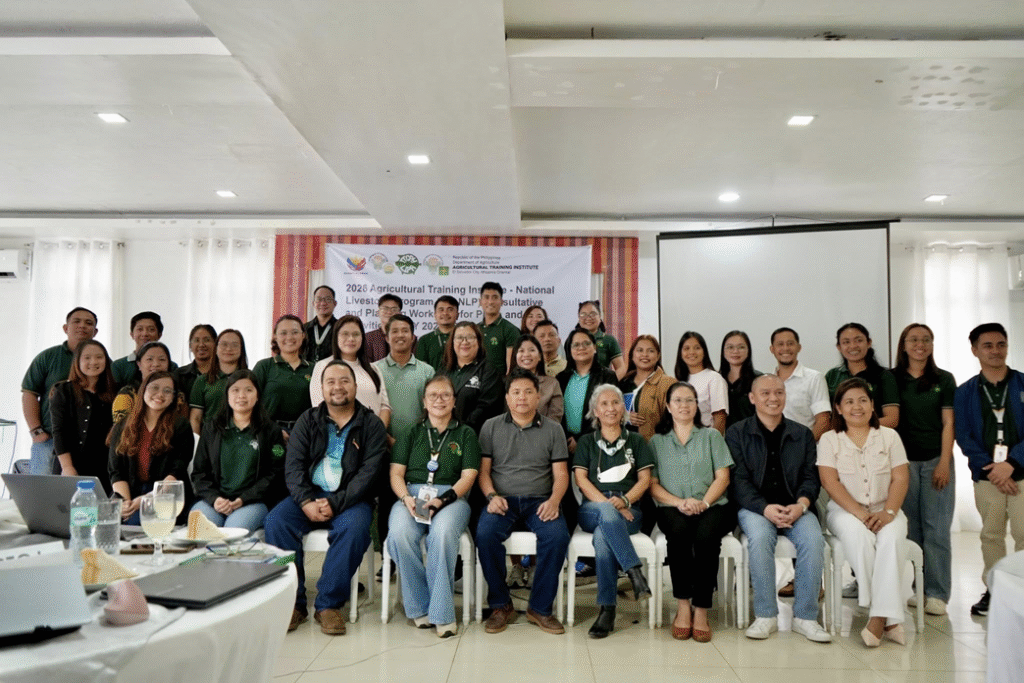
Malaybalay City Mayor Jay Warren Pabillaran (center) welcomes livestock focal persons from across the country to gather in Malaybalay City for a four-day planning workshop led by the Agricultural Training Institute–National Livestock Program to align regional production targets with national demand. The Feb. 17–20 consultative meeting maps out unified strategies on breed improvement, disease control, artificial insemination expansion, and market access to boost local meat and dairy output and raise farmers’ earnings. (Photo courtesy of Malaybalay City Government)